
A Thousand-Year-Old Tradition: Discovering the Stones of Iyo

It all began one day at Atelier DOMA, when two young craftsmen from Ehime Prefecture came to visit me. Mr Yamamoto and Mr Idemoto quarry natural sharpening stones and had travelled to Paris with a selection they wanted me to discover.
During their short stay, we sharpened together. With their guidance, I began discovering their stones: how they felt under the blade, how they behaved, and the sometimes considerable differences from one stone to another.
We quickly bonded over our shared passion for sharpening and stones. Before they left, I made them a promise: next time, it would be my turn to visit them, to discover their mountains and see their work firsthand.
A few months later, I found myself in the mountains of Ehime.
A history spanning more than 1,200 years
Although relatively little known today, Iyo-to (伊予砥) are among Japan’s historic natural sharpening stones. Their use can be traced back more than 1,200 years: documents from the eighth century already mention stones originating from the former Iyo Province, now Ehime Prefecture.
Their history is also closely connected to Tobe-yaki, the region’s celebrated porcelain. But Iyo stones were being quarried long before Tobe-yaki came into existence. In the eighteenth century, the large quantities of waste material produced by stone quarrying found a new purpose: they were used as raw material in the early development of Tobe porcelain.
A mountain of sharpening stones

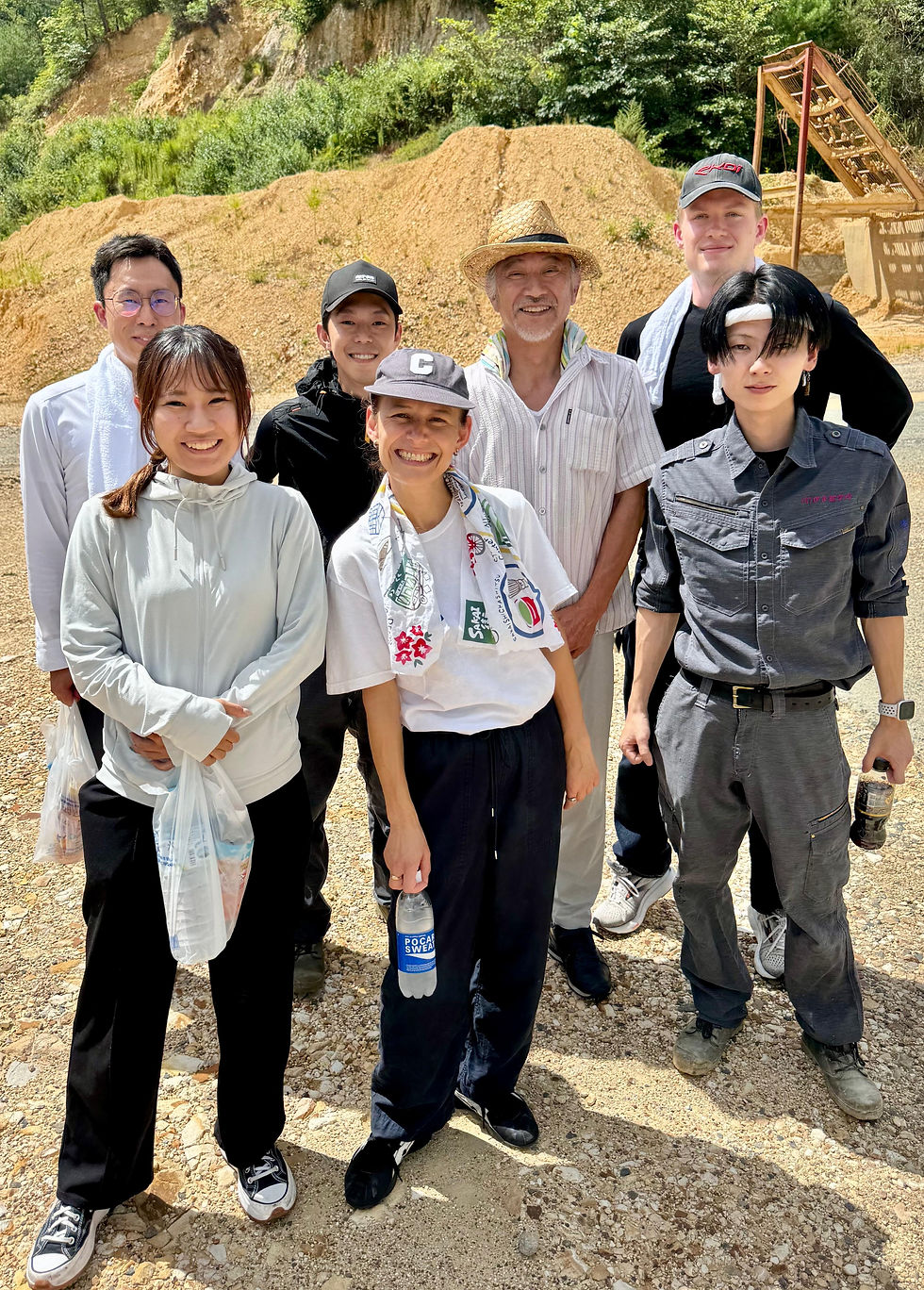
It is a very hot August day in the mountains near Matsuyama. I haven’t come alone. Several friends and partners have joined us, including Mr Hattori, president of Masahiro in Seki. I had told him about the trip only a few weeks earlier while visiting his factory, and he immediately wanted to come along and discover the stones for himself.
The mountain is known for its dry conditions. Pale rock emerges everywhere through the vegetation and, as we make our way upwards, something becomes almost difficult to comprehend: this entire mountain is made of the rock from which these sharpening stones are extracted.
At the end of the only road climbing into the mountain stands the former workshop where the stones used to be processed. It has been closed for almost a year. Mr Yamamoto and Mr Idemoto, however, continue to come here. They maintain the site and still quarry and produce sharpening stones on a very small scale, determined not to let this knowledge disappear.
Before going any further, we stop in front of a tiny shrine outside the workshop. Yamamoto and Idemoto put their hands together in prayer, and we do the same. The shrine is dedicated to the god of the mountain. Each time they arrive, and each time they leave, they come here to pay their respects.
We begin by exploring several old mine galleries. Inside, the air is surprisingly cool after the dry heat outside, but the galleries are fragile. Some appear to be held together by the rock itself, tree roots and carefully stacked stones that we are warned not to touch. Successive earthquakes have made some of the galleries too dangerous for us to enter.
Further up, the quarry opens out onto the mountainside, and we can observe directly the rock from which the stones I first discovered months earlier in Paris are made.
Reading the stone
Their geology is very different from that of the natural stones from Kyoto, with which I am more familiar. Kyoto stones come from sedimentary formations arranged in successive layers.

Here, the geological history is linked to ancient volcanic activity. The area contains formations of volcanic tuff, as well as rocks that have been deeply altered over time by circulating hydrothermal fluids.
Iyo-to contain quartz and clay minerals, among other components. In particular, very fine grains of quartz embedded within a softer matrix contribute to the stone’s abrasive action.
But understanding the geology is not enough to understand a stone.
As we walk, Yamamoto teaches me to look at the mountain differently: the differences between the surrounding mountains, variations in the rock from one place to another, the qualities they look for and the flaws they try to avoid. He also tells me about the people who once worked here and the accidents that have marked the mountain’s history.
Yamamoto himself grew up nearby, at the foot of these mountains. Learning how to quarry, recognise and work these stones was also a way of preserving a craft that belongs to the place where he was born.
Discovering what lies inside
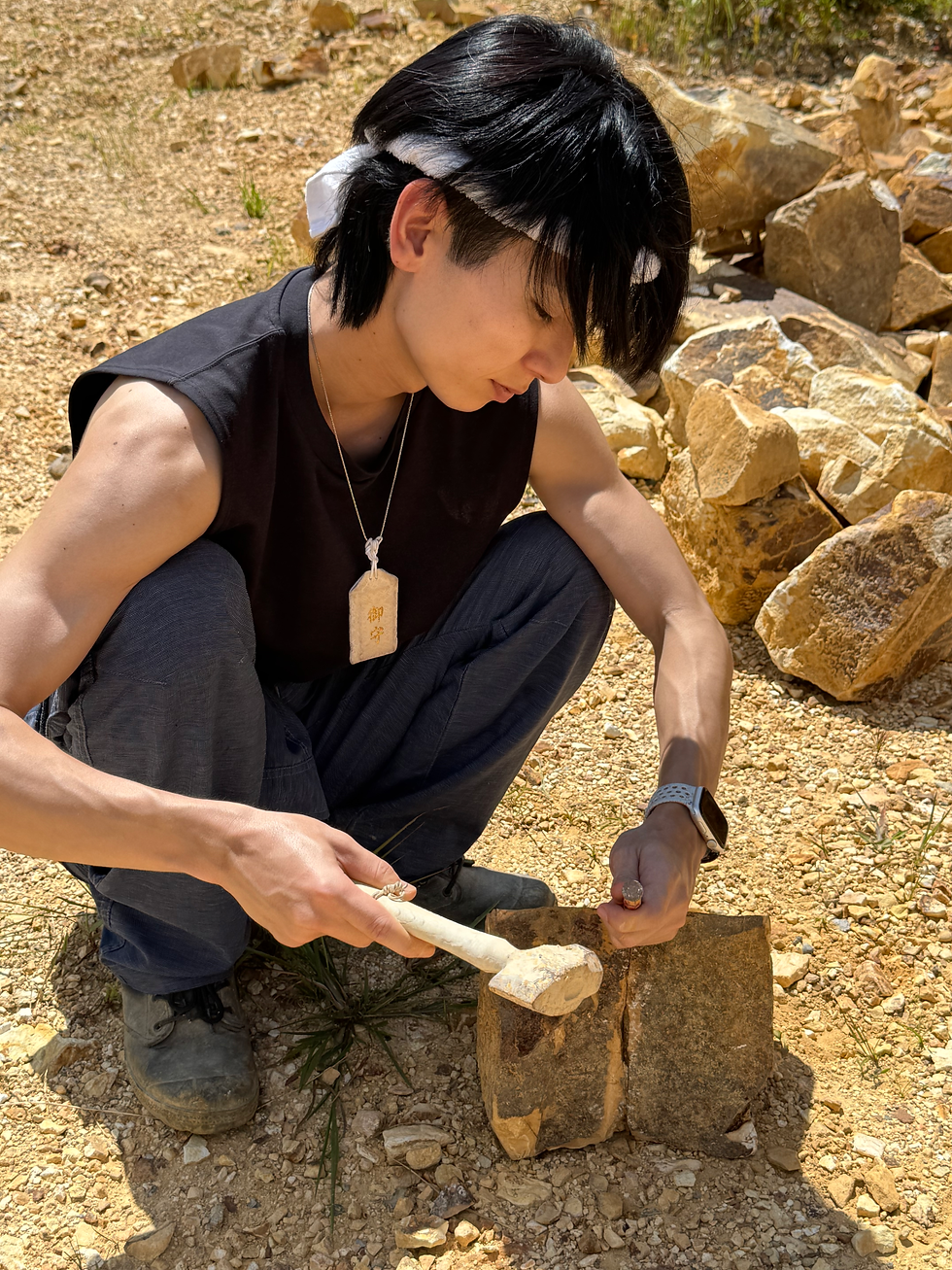
At the top of the quarry, we choose a few blocks. From the outside, it is impossible for me to know exactly what they will reveal.
We carry them back down to the workshop in our arms, along dry, unstable paths, weighed down by the heavy rocks.
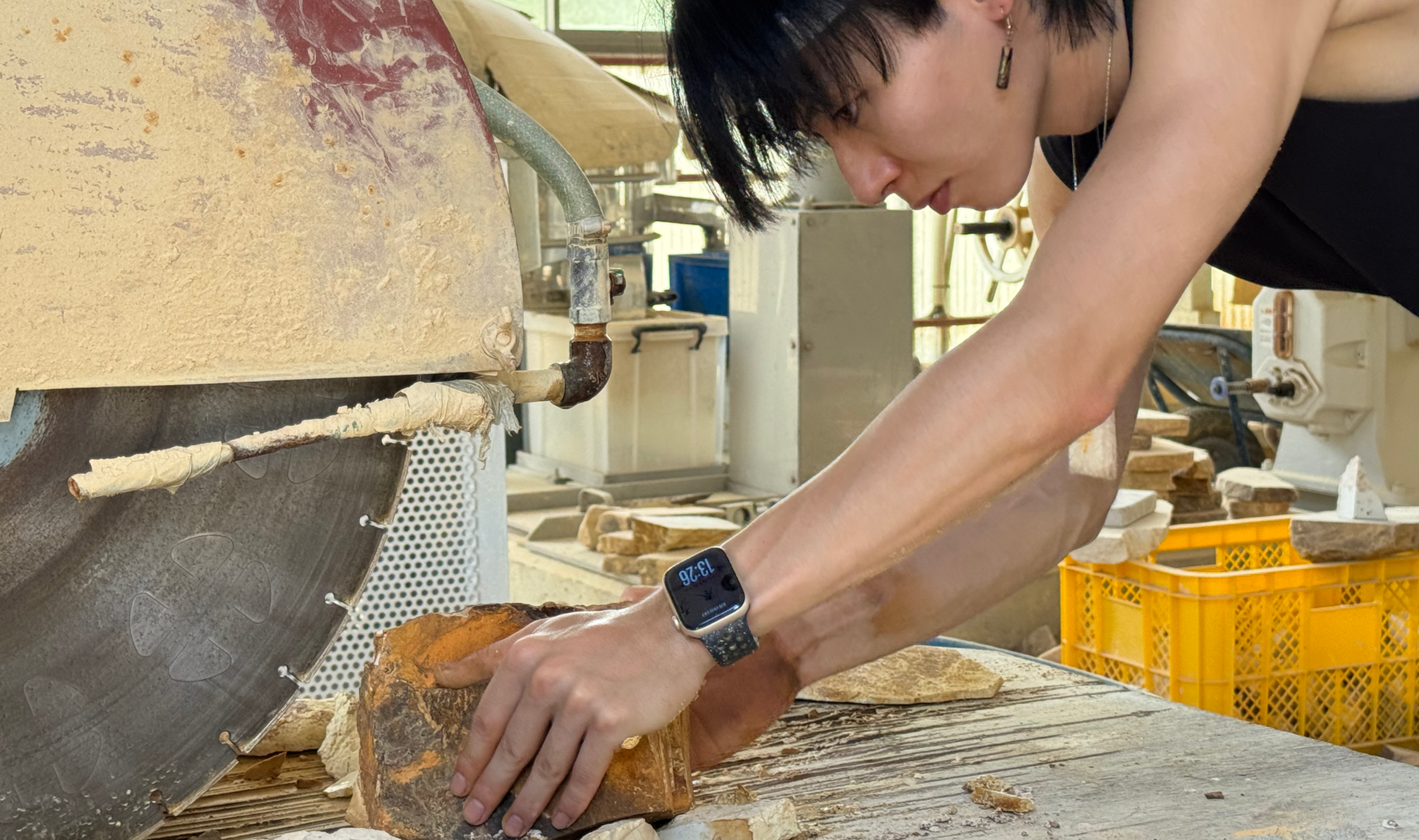
Then comes the moment to cut them open.
In theory, they explain, all these stones can sharpen. But their quality varies enormously. Yamamoto and Idemoto regularly climb the mountain to select blocks, carry them down by hand, cut and flatten them, and finally test each one.
After all that work, only around 5% are kept.
We put our finds through the saw. The stone chosen by Mr Hattori turns out to be magnificent: extremely fine, very homogeneous and with no apparent flaws. Even Yamamoto and Idemoto are impressed by its quality.
Perhaps this is what fascinates me most about natural stones. You can learn to read a mountain, recognise a promising rock, observe its colour and texture, yet there will always be an element of the unknown.
You have to open the stone. And above all, you have to sharpen on it.
Back to sharpening

There, I discover the stones they make to order, some of the finest pieces they have carefully kept aside over the years, and Yamamoto’s collection of natural stones from other regions of Japan, assembled during his years of learning the craft.
And then we return to what first brought us together in Paris: sharpening.
We compare the stones we have just collected with those in their collection: how they feel, their speed, the slurry they produce, how they react with different steels and the fineness of the resulting edge and finish. We compare our movements too, exchanging techniques, habits and ways of interpreting the feedback a stone gives us.
The conversations continue over dinner that evening.
A natural sharpening stone is never simply a tool. Behind it lies a geology, a mountain and centuries of history. But there are also people, gestures and an intimate knowledge of the land that can never be learned entirely from books.
At the end of the day, before leaving the mountain, we return once more to the small shrine outside the workshop. Just as we had done when we arrived, we put our hands together before the god of the mountain.
Then we make our way back down.
Iyo stones at DOMA
You can discover the Iyo natural stones, now available both at Atelier DOMA and through our online shop.
We also have a small batch of conglomerate sharpening stones handmade by Yamamoto using Iyo stone powder. Production of these stones ceased almost a year ago, making these some of the last remaining pieces from his production.
As every natural stone is unique, please contact us directly by email if you would like further information or advice on choosing the right stone for you.


Comments