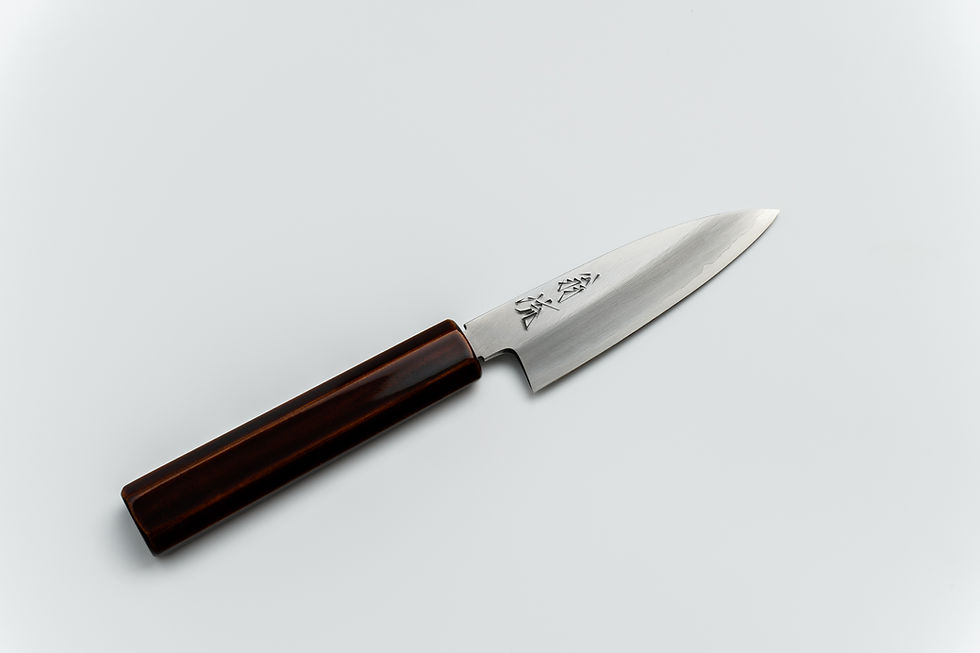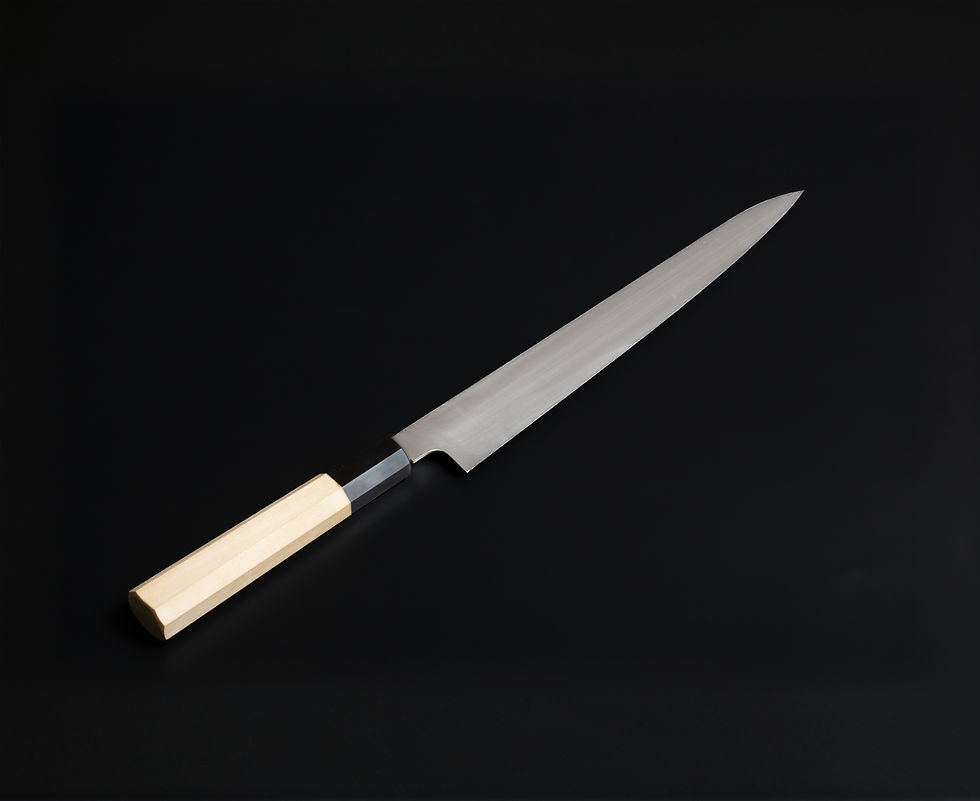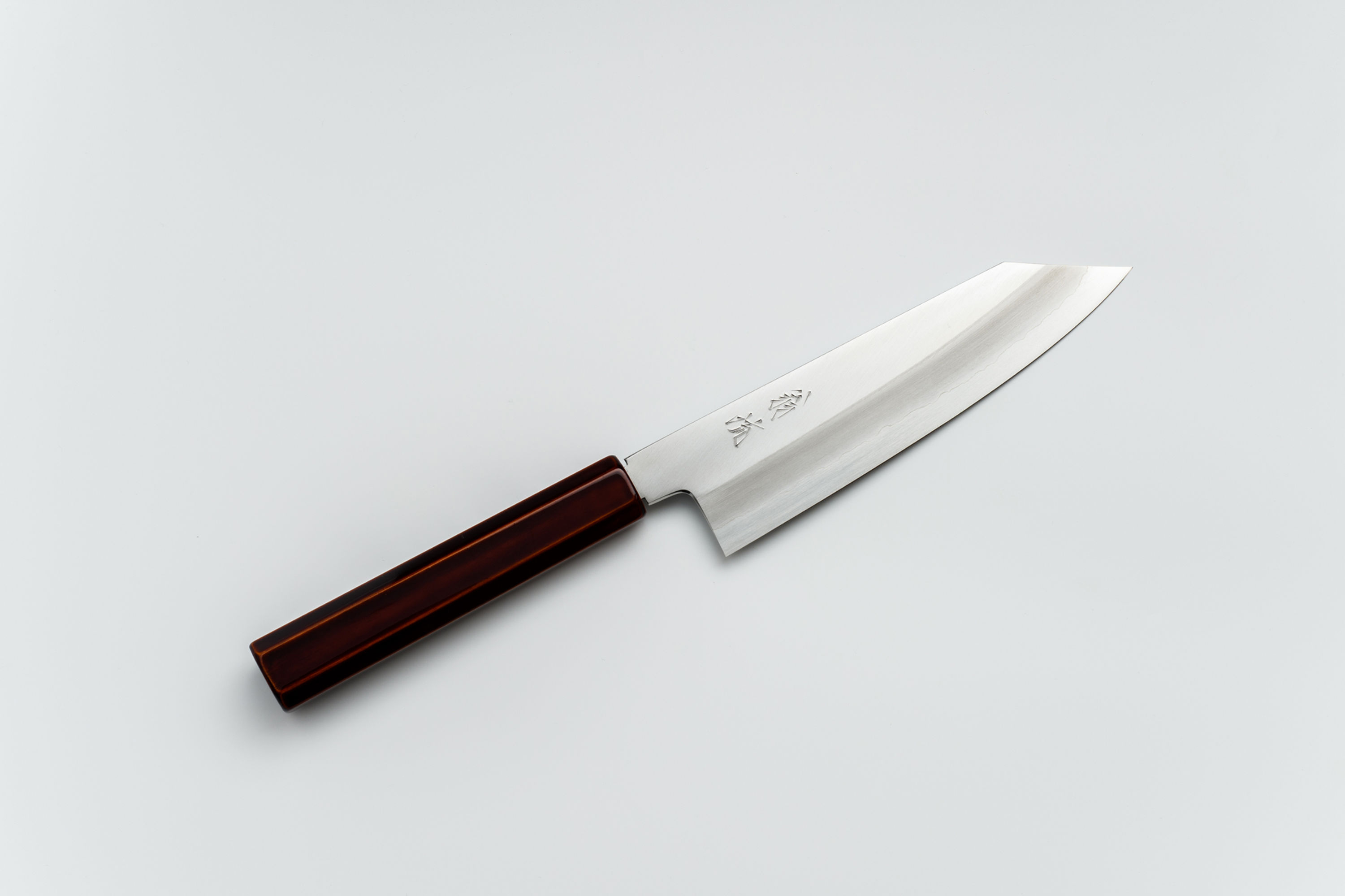

Santoku knife with cherry wood handle lacquered by traditional Japanese method "Kijiro" glossy.
Ginsan steel (stainless), blade size 18 cm.
The shape of the knife called "kiritsuke-santoku", is a santoku whose tip has been cut diagonally to create a shape called "ken-gata" or "kiritsuke". Its use remains the same as a regular santoku (un domestic-sized multifunction knife) but it has a thinner and sharper tip for very precise cuts . Ideal for cutting and slicing medium to large sized foods. Very light and compact, it is a medium-sized knife suitable for everyday cooking.
It is also very elegant as a serving knife to cut a nice piece of meat (or any other dish) on the table.
The blade is made of Japanese Gin-san steel, a "stainless" steel, forged. Its very high hardness (59-62 HRC) gives it a long lasting edge and the fact that it is forged (not simply cut into its shape) allows for finer sharpening.
A "stainless" steel is actually simply more resistant to oxidation, but it is ideal for cutting any food, even acidic fruits, without showing immediate oxidation. It is therefore relatively easier to maintain, however it must always be washed by hand and dried well with a cloth.
The handle is made of cherry wood lacquered by traditional method in Kanazawa, renowned for its lacquer craftsmanship. Traditionally used on wooden tableware to strengthen the material and make it durable, lacquer is also used for its aesthetics and to reflect light. Its shine will evolve over time and become more beautiful.
This knife was forged, sharpened and assembled in the tradition of clean Japanese cutlery in Sakaï (Osaka prefecture), the cradle of Japanese knives.
We work closely with the craftsmen and distributors of our products, do not hesitate to contact us if you have questions.
Care advice:
The blade is made of "stainless" steel, (Gin-san steel) but it should be understood as a steel that is only more resistant to oxidation, because all knives are actually oxidizable.
Must therefore wash and dry knives as soon as possible after use.
The knife (blade and handle) washes by hand with dishwashing liquid and an ordinary sponge, then wipe with a towel.
Never dry with hot air. Do not machine wash. Do not wash the lacquer handle with abrasive sponges.
Keep the knife in a dry place.
Avoid hard foods. For hard vegetables (pumpkin type), or foods that may contain bones or bones, keep a special knife at home, thicker or at the end of its life, a knife that is not afraid of being a little chipped. Reserve your good knives for safe cuts.
Sharpening or honing:
No knife is eternal, they all need to be sharpened at one point. And it is up to each user to determine when it no longer cuts enough and therefore needs to be sharpened. Do not expect too much once it cuts less well, the more it will be worn the longer it will take to repair. Avoid the use of the rifle, prefer a sharpening on stone.
To learn or improve stone sharpening, we offer workshops this way !
For any other information, write to us in the contact box.